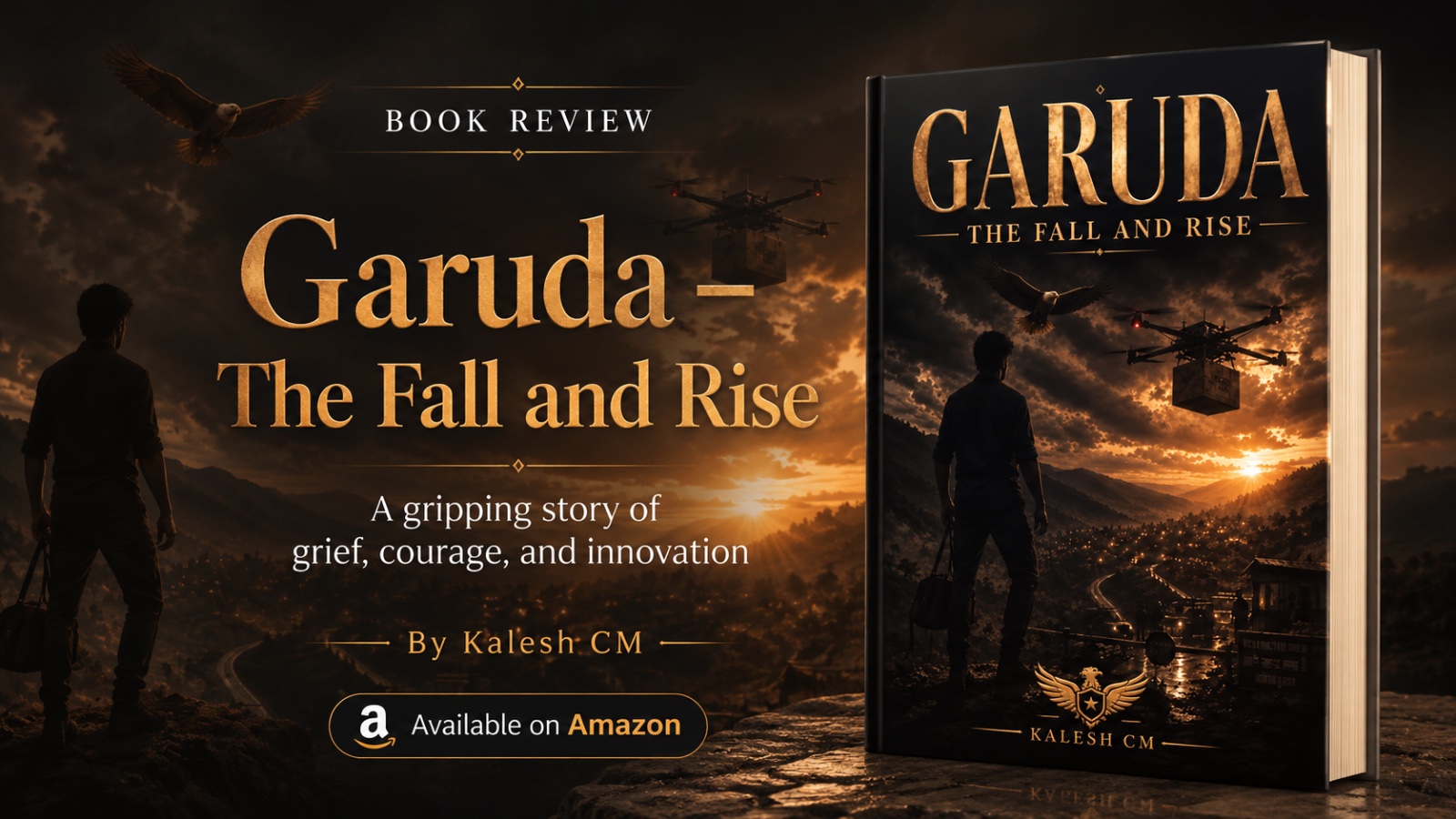
When Grief Learns to Fly
Author: Kalesh CM • Genre: Social-Techno Thriller • Rating: 4.2/5
A powerful story in which personal loss becomes evidence, engineering becomes resistance, and a village builds a path above the roads controlled by the powerful.
A Tragedy Rooted in a System
Kalesh CM’s Garuda - The Fall and Rise is an ambitious social-techno thriller that transforms a personal tragedy into a larger story about corruption, rural neglect, engineering, and collective resistance. Set around Shirur and the Sahyadri landscape, the novel begins with an image that is both cinematic and morally unsettling: a truck carrying counterfeit inhalers passes through a checkpoint after a bribe changes hands. The medicine looks genuine, but its canisters contain baking soda, chalk, and gypsum. Death is travelling through a legitimate supply chain, disguised as hope.
At the centre of the novel is Vikram, a mechanical engineer who has returned to village life and uses his technical skills to repair broken pumps and machines. His world changes when his asthmatic father, Yashwant, dies during a dust storm after using a counterfeit inhaler. The scene is emotionally forceful because the tragedy is not presented as fate. It is the result of an engineered system in which corruption, poverty, weak healthcare access, and indifference work together.
Vikram’s grief does not immediately turn him into a conventional action hero. It first turns him into an investigator. He dismantles the inhaler, studies its weight and contents, and discovers that the product contains no medicine. That detail defines the novel’s approach: anger is important, but evidence is stronger. Vikram’s pain gradually becomes data, design, and purpose.
Community Is the Real Hero
The narrative gains depth through the community that forms around him. Ananya, a schoolteacher, is more than a supportive companion. She understands people, language, accountability, and the practical needs of village families. While Vikram structures problems like an engineer, Ananya ensures that the system remains accessible and human. Chhotu, the inventive mechanic, brings humour, improvisation, and workshop intelligence, while Kaka’s knowledge of forgotten shepherd trails proves that local experience can be as valuable as formal education. Together, they represent the novel’s strongest idea: transformation does not arrive through one extraordinary saviour, but through ordinary people combining different kinds of knowledge.
Technology Designed for Real Lives
The creation of V-Link is one of the book’s most convincing elements. Instead of designing a fashionable smartphone application for people with stable internet and digital payment access, the team builds a missed-call and SMS-based ordering network for basic phones. This is technology shaped by the lives of its users rather than by urban assumptions. The system records orders, verifies medicine, preserves batch details, and creates multiple records so that no middleman can quietly rewrite the chain.
Garuda, the cargo-carrying multirotor built from discarded motors, medical equipment, scooter parts, and salvaged batteries, becomes the physical symbol of the novel. Its name is fitting: it is a carrier, an enemy of serpents, and a machine that makes an oppressive road irrelevant. The construction sequences are detailed enough to make the invention feel earned. The team experiences instability, overheating, broken propellers, failed payload tests, and limited battery capacity. A particularly effective moment occurs when Vikram abandons his original twenty-kilogram target and accepts a safe payload of twelve kilograms. The change is not defeat; it is mature engineering. The novel repeatedly argues that responsible innovation depends on testing, documentation, correction, and humility.
Where Emotion and Engineering Meet
The emotional and technical strands come together powerfully when Garuda carries antivenom across a flood to save a child. The aircraft does not return intact, but the medicine survives. Vikram’s reaction is not triumph; it is release. Where his father once died beside an empty road, this time essential treatment reaches the patient because the community has created another route. The contrast gives the machine meaning beyond spectacle.
The novel also examines another kind of danger: capital that offers scale by demanding control. When Vikram presents the project to investors in Mumbai, he discovers that polished language about “underserved markets” can conceal the same disregard shown by rural monopolies. The proposed smartphone-first model would exclude the very communities V-Link was designed to serve. This section widens the conflict from one corrupt strongman to a broader question: who owns innovation, and whose convenience defines progress?
Writing, Pace, and Editorial Note
Kalesh CM writes with strong visual energy. Dust storms, flooded rivers, scrapyards, classrooms, highways, and glass offices are rendered through clear contrasts. Short sentences and fragments often create urgency, especially during emergencies and mechanical tests. However, the print proof contains frequent repetitions of sentences and ideas. While repetition can intensify grief or danger, its heavy use occasionally interrupts momentum and makes some scenes feel longer than necessary. A careful editorial pass would make the prose sharper and allow the strongest images to carry more weight.
Final Verdict
Despite this, Garuda - The Fall and Rise succeeds because its social concerns are embedded within a compelling plot. It addresses counterfeit pharmaceuticals, last-mile healthcare failure, rural connectivity, corporate responsibility, local monopolies, and ethical entrepreneurship without losing sight of the people affected by these systems.
This is a story about technology, but its deepest subject is dignity. Vikram does not build Garuda merely to defeat Gajraj Singh. He builds it so that a child can breathe, a patient can receive verified medicine, and a village can ask for what it needs without seeking permission from the powerful. Readers who enjoy socially conscious thrillers, grassroots innovation, emotionally driven engineering stories, and narratives of resistance will find Garuda - The Fall and Rise both relevant and inspiring.
4.2 / 5
Recommended for readers of socially conscious thrillers, rural innovation stories, and technology-driven fiction.
Review prepared from the supplied 2026 print proof.